
Red Hatched Road Markings: What They Mean and How to Respond
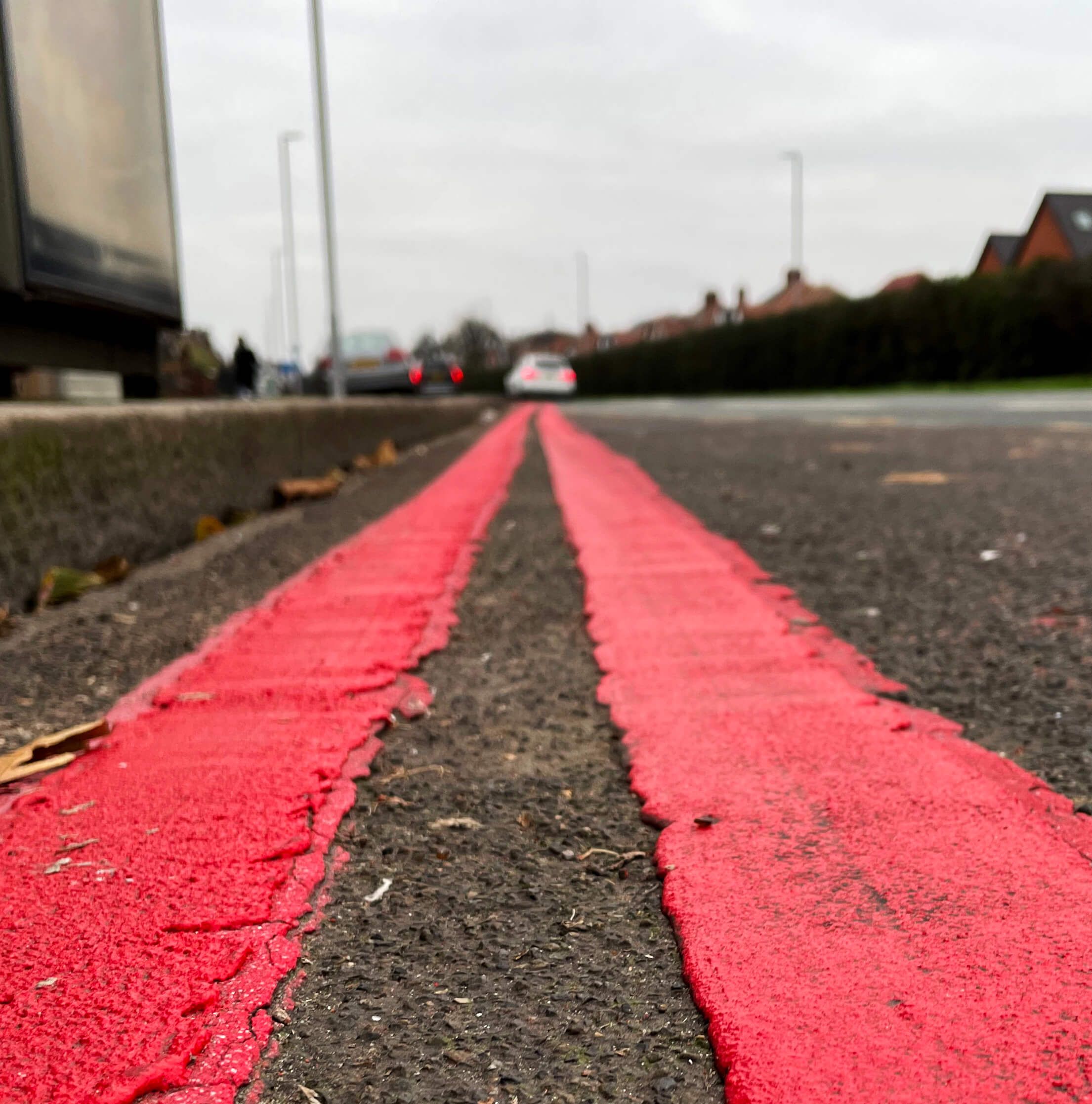
Red Hatched Road Markings: What Do They Mean?
Red hatched road markings can be striking, but their meaning is not always obvious. In the UK, the colour red is often used to make a road surface more visible or to provide extra grip. The red colour alone does not necessarily create a traffic restriction: drivers should also look at the pattern of the markings, any boundary lines and nearby signs.
What are red hatched markings?
These markings usually combine a red road surface with diagonal stripes or chevrons. They may be used to highlight an area where vehicles should not normally drive, or to draw attention to a particular road feature. Red, high-friction surfacing is also used at locations such as junction approaches, bends and pedestrian or cycle crossing points.
There is no single nationwide meaning that applies to every red-hatched area. The markings and signs at the specific location determine what drivers must do.
How to read the hatching
Diagonal white stripes and chevrons are commonly used to mark areas that traffic should avoid. Under the Highway Code, whether a driver may enter a hatched area depends on its boundary:
- Broken white boundary: You may enter the area if it is necessary and safe to do so.
- Solid white boundary: You must not enter the area, except in an emergency.
Where hatching appears on a red surface, do not assume that the red colour changes these rules. Check the boundary lines and follow any signs or signals. If the markings are unclear, take the cautious option and stay out of the hatched area.
Why is red surfacing used?
Red surfacing can help a road feature stand out, especially where drivers need to pay particular attention. It may also be made from a high-friction material to improve tyre grip, for example on an approach to a junction or on a bend. The precise purpose varies by location, so red surfacing should be treated as a warning to look carefully rather than as a complete instruction in itself.
Red hatching is not the same as a yellow box
A yellow box junction has a specific purpose and rules: drivers must not enter it unless their exit road or lane is clear, subject to limited exceptions such as turning right. A red-hatched area is not automatically a yellow box junction. Follow the markings and signs that are actually present.
Similarly, red surfacing may be used in or near a bus lane or cycle route, but the colour alone does not tell you when that lane may be used. Look for the lane markings, signs and operating times.
What should drivers do?
- Look ahead and reduce speed if the road layout or surface suggests a potential hazard.
- Check whether the hatched area has a broken or solid boundary.
- Read nearby signs and follow traffic signals.
- Do not stop or wait in the area unless permitted or necessary in an emergency.
- Avoid sudden manoeuvres; leave enough space and time to respond safely.
In summary
Red hatched road markings are used to make particular areas more noticeable, but red does not have one universal legal meaning on its own. The hatching, boundary lines, signs and road layout provide the important instructions. When in doubt, follow the Highway Code, observe the signs and avoid entering the marked area unless it is clearly permitted and safe.
7 Tips for Navigating Red Hatched Road Markings Safely
- Treat red hatched areas as restricted unless signs say otherwise.
- Check nearby signs for the exact rules and times.
- Don’t stop or park on the markings unless permitted.
- Avoid entering the hatched area unless your route requires it.
- Keep clear of junctions, crossings and access points.
- Watch for cyclists and other road users when moving around the markings.
- If unsure, follow the signs and choose another place to stop.
Treat red hatched areas as restricted unless signs say otherwise.
Treat red-hatched areas as restricted unless signs or road markings clearly indicate otherwise. Avoid driving or stopping in them, and check any nearby signs and boundary lines before proceeding. If the instructions are unclear, stay out of the area where it is safe to do so.
Check nearby signs for the exact rules and times.
Always check nearby signs when you see red hatched road markings, as they explain the specific restrictions that apply at that location. Signs may indicate who can use the area and at what times, particularly where the markings are near a bus lane, cycle route or other restricted zone. Don’t rely on the red colour alone: follow the signs and road markings together.
Don’t stop or park on the markings unless permitted.
Do not stop or park on red hatched road markings unless signs or local rules specifically permit it. Stopping there can obstruct traffic, reduce visibility or create a hazard for other road users. Check nearby signs and road markings, and if you are unsure, keep the area clear.
Avoid entering the hatched area unless your route requires it.
Avoid entering a red hatched area unless your route requires it and it is safe and permitted to do so. Check the boundary markings and any nearby signs before moving across it, as a solid boundary generally means you must not enter, except in an emergency. If you are unsure, stay clear and continue only when you can do so safely.
Keep clear of junctions, crossings and access points.
Keep clear of junctions, crossings and access points marked with red hatching. Stopping or parking in these areas can obstruct visibility, block pedestrians, cyclists or other vehicles, and make it harder for traffic to move safely. Always check nearby signs and road markings, and leave the space unobstructed unless an emergency requires you to stop.
Watch for cyclists and other road users when moving around the markings.
When moving around red hatched road markings, stay alert for cyclists, motorcyclists, pedestrians and other road users who may also be navigating the area. Check your mirrors and blind spots, signal clearly and give others plenty of space. Avoid sudden lane changes or sharp manoeuvres, and only move across the markings when it is permitted and safe to do so.
If unsure, follow the signs and choose another place to stop.
If you are unsure what red hatched road markings mean, check the nearby signs and avoid stopping in the marked area. Choose a safe, permitted place to stop instead, so you do not obstruct traffic or put other road users at risk.